You're on the Ormi list. Time to find out what your hormones have been up to.
Keep an eye on your inbox.
Hormone intelligence for perimenopause and beyond
Everything you've been feeling finally makes sense.The anxietyThe brain fogThe exhaustionEverything you've been feelingfinally makes sense.
You're not imagining it. You're not too sensitive. And you're not the only one.
Ormi puts how you feel first. Then it connects your hormones, your wearable, your daily check-ins and your life. So you can see what's working, and walk into your GP with data.
Ormi isn't on the App Store yet. Join the waitlist to register your interest and we'll let you know as soon as it's ready.
You're on the list. We'll be in touch soon.
No spam. Ever. Just Ormi when it's ready. See our privacy notice.
If you don't feel like yourself lately, you're not alone.
Mood swings, low mood, brain fog and broken sleep are all recognised symptoms of perimenopause and menopause, when levels of oestrogen and progesterone are changing. Ormi helps you notice your own patterns.
A regular cyclePerimenopause
An illustration, not real data. Oestrogen rises and falls through the cycle, and becomes less predictable in perimenopause.
Anxiety
"I feel anxious all the time and I don't know why."
What may be behind it
OestrogenProgesteroneCortisol
Changing oestrogen and progesterone levels may play a part, and anxiety can be part of perimenopause. Cortisol, the hormone that helps your body respond to stress, is part of the picture too.
How Ormi helps
A daily check-in helps you see when it shows up.
Broken sleep
"I wake up at 3am with my heart racing. I'm exhausted but I can't sleep."
What may be behind it
OestrogenProgesteroneMelatoninCortisol
Changes in oestrogen and progesterone can affect the sleep cycle, and night sweats can wake you. Sleep also depends on melatonin, which rises at night, and on cortisol, which normally falls through the day.
How Ormi helps
Ormi brings your sleep, your check-ins and your wearable together.
"Normal" results
"My GP said my bloods are normal, but something is clearly not right."
What may be behind it
Fluctuating levels
Hormone levels rise and fall in perimenopause, so a single blood test can look normal.
How Ormi helps
Ormi helps you build a record of how you feel over time, to take to your GP.
Mood swings
"I snap at my kids and then cry about it. I don't recognise myself."
What may be behind it
OestrogenProgesterone
Mood swings are a recognised symptom of perimenopause, when oestrogen and progesterone levels are both changing.
How Ormi helps
Seeing the pattern makes it easier to talk about.
Low energy
"I'm so tired all the time. Coffee doesn't even touch it."
What may be behind it
OestrogenCortisolThyroid
Lower oestrogen is linked with low energy, and broken sleep adds to it. Cortisol is normally highest in the morning. Tiredness has other causes too, such as anaemia or a thyroid problem, which a GP can check with a blood test.
How Ormi helps
Ormi helps you see how your sleep and your energy move together.
Brain fog
"My brain just isn't working. I forget words. I lose my train of thought."
What may be behind it
Oestrogen
The NHS lists brain fog as a common symptom, and lower oestrogen is thought to play a part. You're not making it up.
How Ormi helps
Ormi helps you notice what makes the fog lighter or heavier for you.
Mental health first
Ormi starts with how you feel.
Then it helps you look at what might be behind it. Try it. How are you feeling today?
Anxiety & low mood
Both can be part of perimenopause and menopause, when oestrogen and progesterone levels are changing. Ormi's daily check-in uses words, not scores, so you can say how you feel in seconds.
Mood swings
The snap, then the regret. Mood swings are a recognised symptom. Ormi gives you CBT-based tools for the moment, and a record of when it happens.
Brain fog
Memory and concentration can change, and lower oestrogen is thought to play a part. Ormi helps you notice what makes the fog lighter or heavier for you.
Sleep
Changes in oestrogen and progesterone can affect sleep, and broken sleep can make everything else feel harder. Ormi has wind-down tools for the evening, and reads your sleep from your wearable.
One slow breath.
This is one of the nervous system tools inside Ormi. In for four, out for six. Three rounds takes thirty seconds.
Ready when you are
Ormi does not replace your GP. If you're worried about your mental health, please speak to them.
Your hormones aren't the problem. They're messengers.
Hormones carry signals all day long. In perimenopause, levels of oestrogen and progesterone change, and that can change how you feel.
Nobody teaches you how to read those signals. Ormi helps you notice patterns across your check-ins, your wearable and your results, so you can have a better conversation with your clinician.
Oestrogen
Levels rise and fall through the cycle, and become less predictable in perimenopause.
Progesterone
Made after ovulation each cycle. Levels change as cycles become irregular.
Cortisol
Often called the stress hormone. It normally follows a daily rhythm, higher in the morning and lower at night.
DHEA, testosterone, melatonin + more
The DUTCH test also looks at these, along with how hormones are broken down.
How Ormi helps
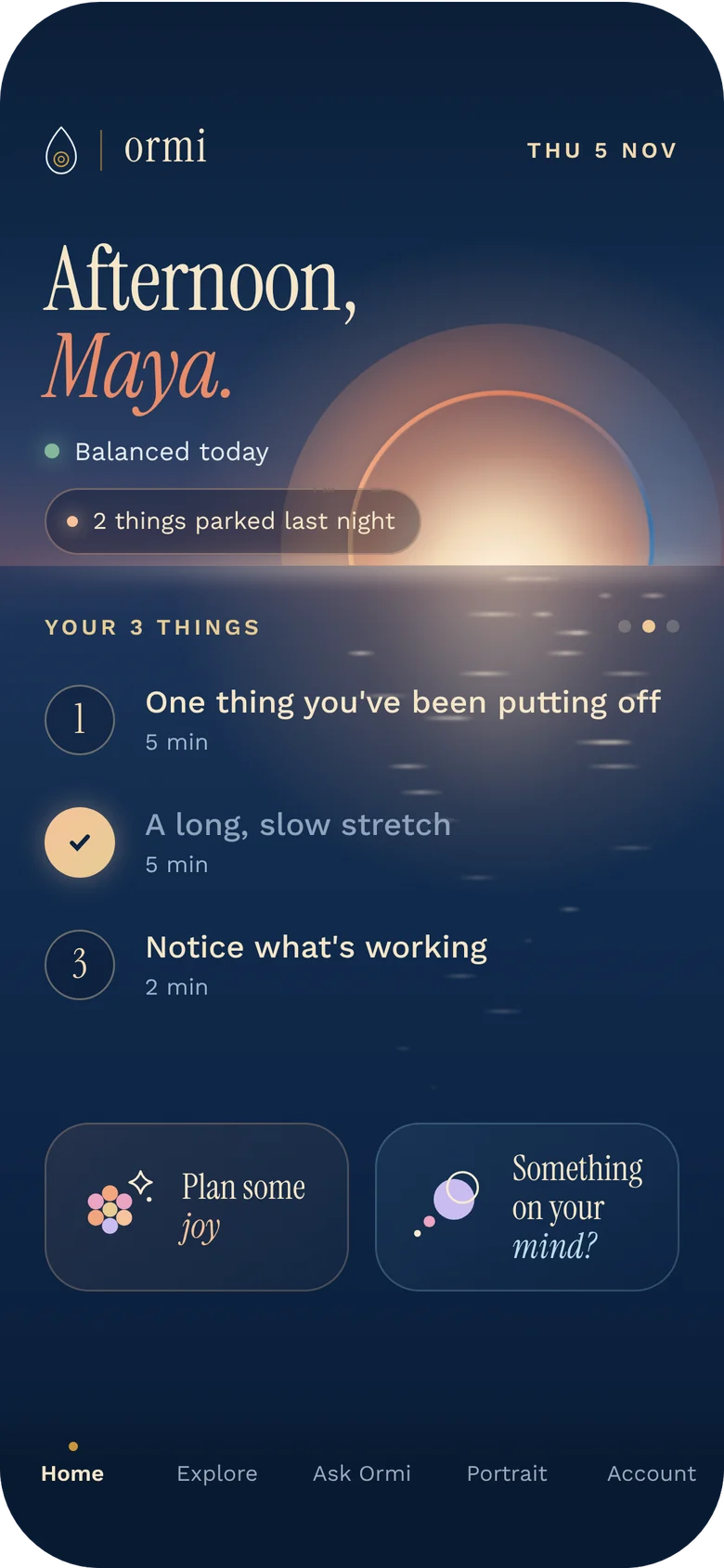
Ormi isn't a tracker. It's a daily companion that helps you understand how you feel and decide what to do next.
1
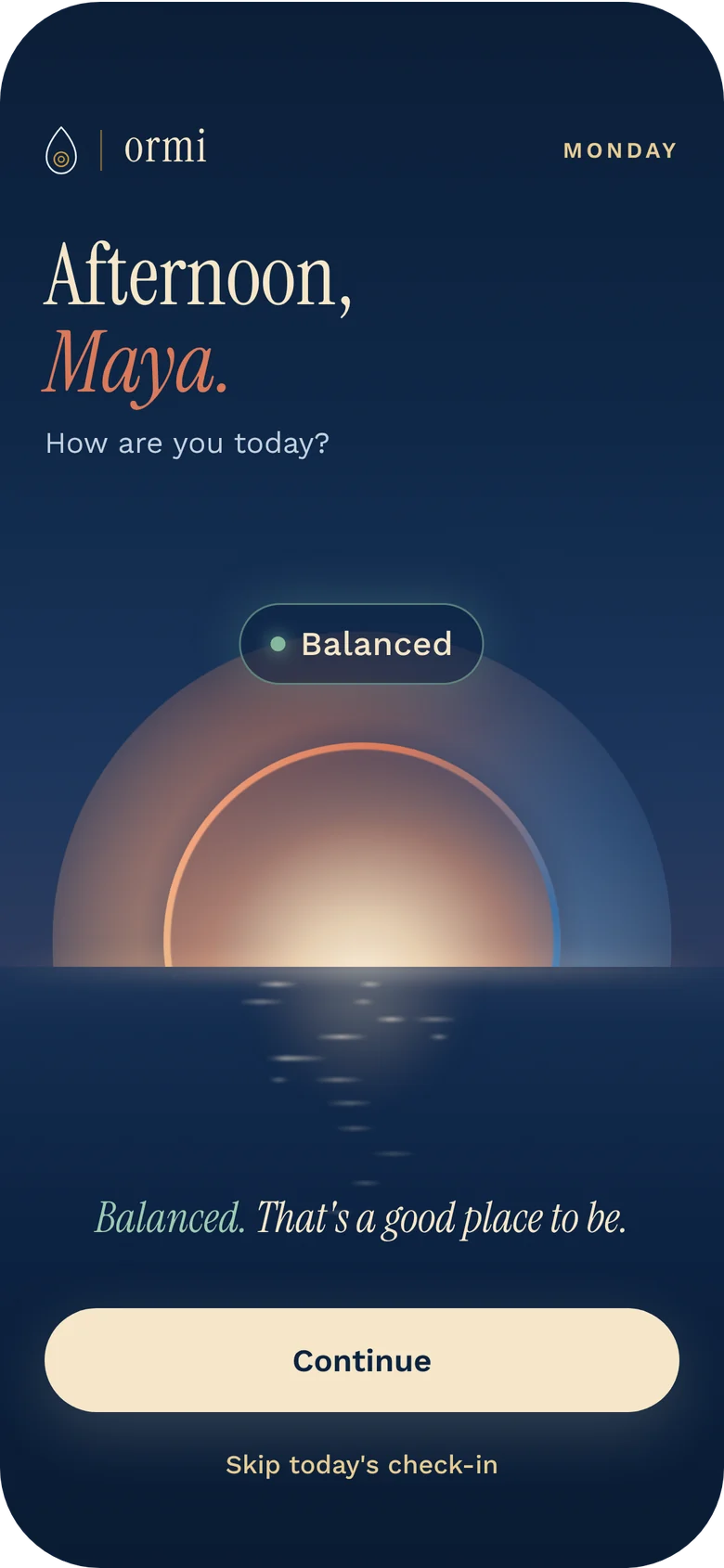
Check in with a word
Pick the word that fits how you feel today. No scores, no numbers. Over time, Ormi shows you patterns across your check-ins, your symptoms and your wearable.
2
Get three small things for today
A short plan built from how you feel and what is on your mind, with CBT-based tools, nervous system tools and wind-down for sleep.
3
Tools for body and mind
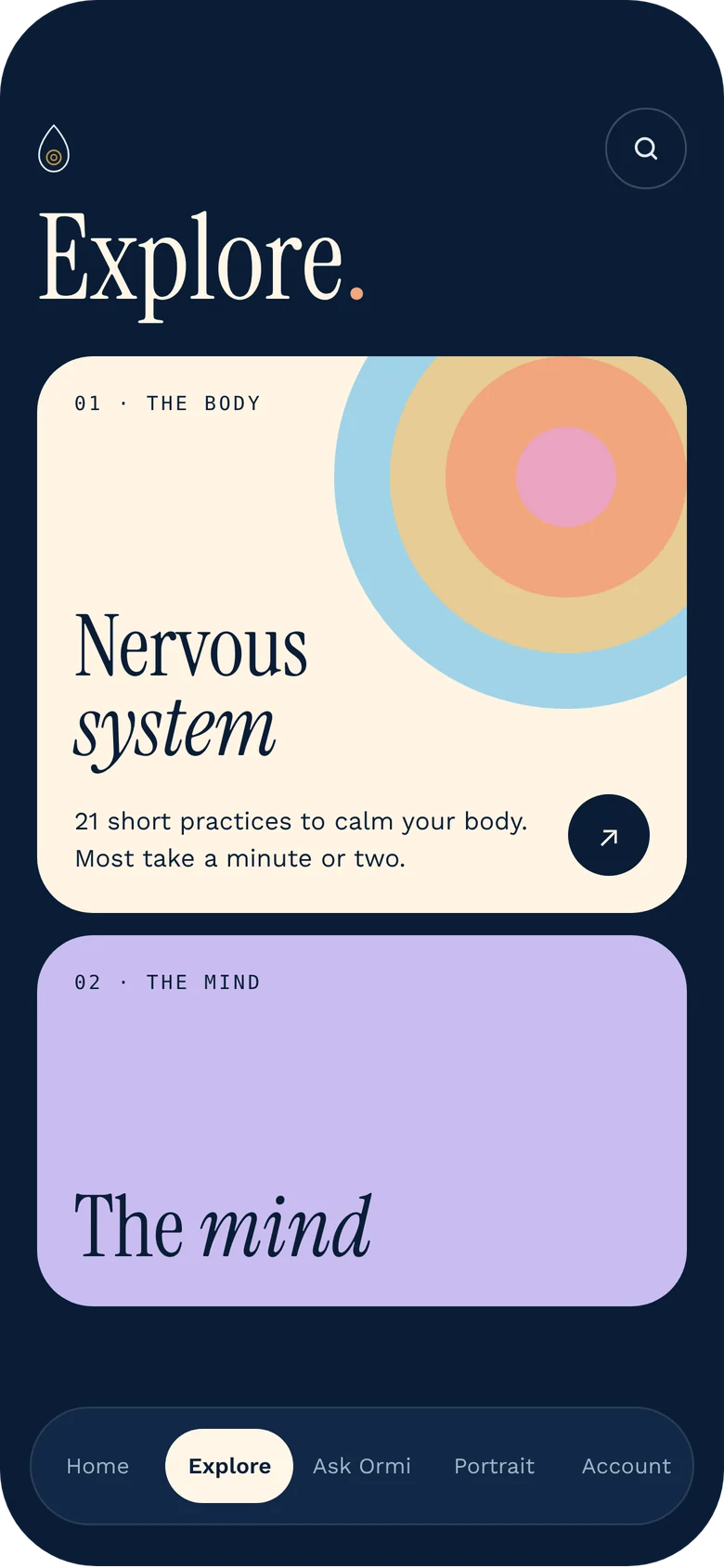
Short practices for your nervous system and your mind. Most take a minute or two.
4
A place for sleep
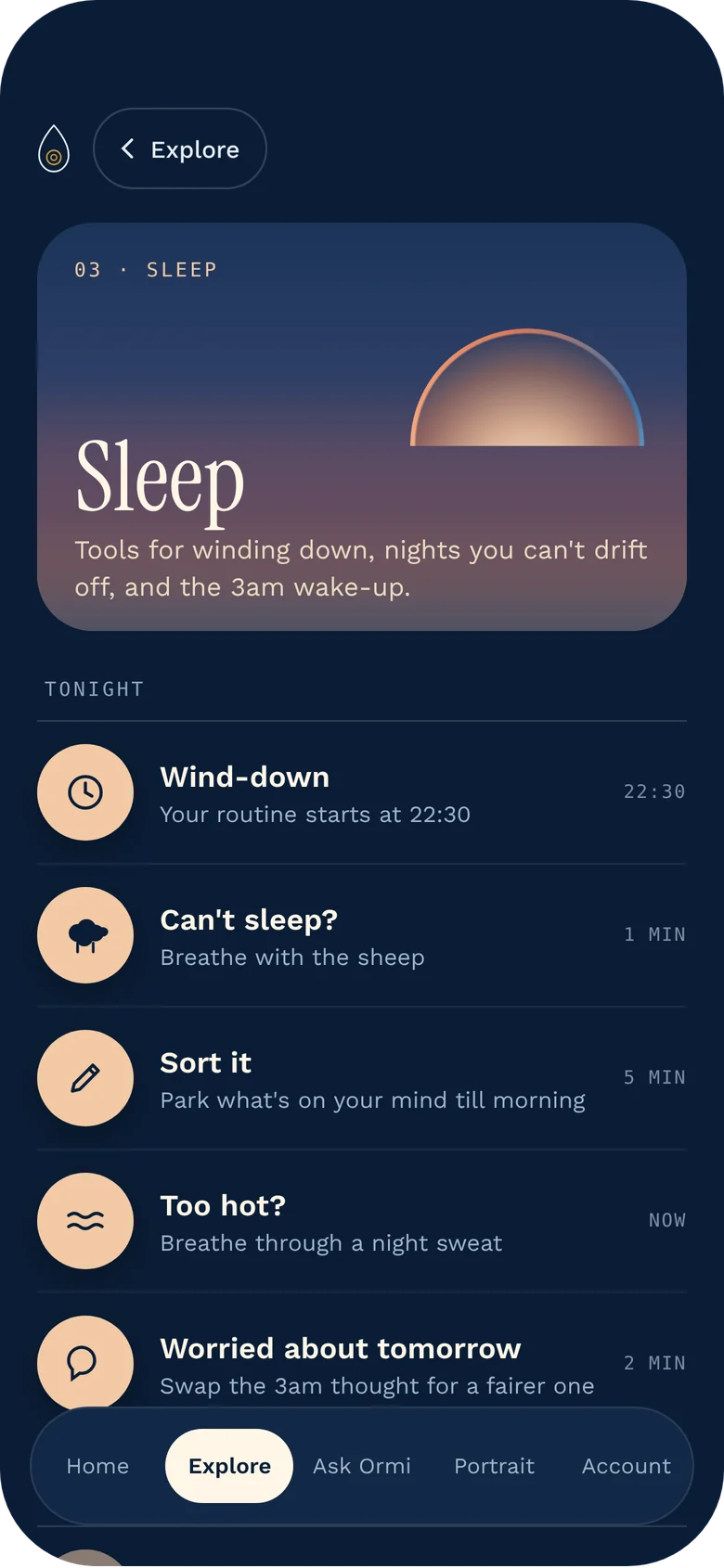
Wind-down routines and tools for the nights you wake at 3am.
These are design previews. Ormi is still being built, so the finished app may look a little different.
And when you want to do something about it
Nervous system tools
Short practices to calm your body. Most take a minute or two.
Mind tools
CBT-based exercises for anxious thoughts, low mood and the worries that keep circling.
Sleep
Wind-down routines, and tools for the nights you wake at 3am.
Nutrition
Food tips matched to the stage you're in. Recipes with Ormi Circle.
Live coaching Ormi Circle
Live sessions led by specialists.
Community Ormi Circle
A members' space to talk with women going through the same thing.
Core tools and food tips are free. Recipes, live coaching, community and the full tool library are part of Ormi Circle.
Also part of Ormi: synced wearables, at-home DUTCH testing and a GP review of your results.
Always up to date
Not a one-off result. A picture that moves with you.
A test result is one moment in time. Ormi keeps listening. Each check-in you make, each night of sleep from your wearable and each result you add updates your picture.
Then Ormi turns it into a plan for today. Three small things, chosen from what you've told us, so you always know what to do next.
Your week
M
T
W
T
F
S
S
Today you saidWired
Today's plan
A nervous system tool
One slow breath
Wind-down for sleep
An example. Tap a day to see how the plan changes. Your plan is built from your own check-ins.
Wherever you are right now.
Ormi is built for every moment of hormonal change. We're focused on perimenopause first, but Ormi is relevant to you, whatever stage you're in.
Regular cycle
Tools and tips that follow the phases of your cycle, so you can see how you feel week by week.
Postpartum
Hormone levels change quickly after birth. Ormi gives you a calm place to check in, and tools for the moment. It does not replace your midwife, health visitor or GP.
Perimenopause
Cycles change. Sleep changes. Mood changes. Ormi helps you make sense of the pattern and plan around where you are.
Menopause
Beyond hot flushes. Ormi helps you keep track of sleep, mood and what's working, with clarity, not alarm.
Tests, explained
Three ways to test your hormones. Only one follows them through the whole day.
Hormones don't hold still. They shift through the day and through the month. So what a test can tell you depends on how much of that it sees.
1 to 3 hormones
Strip tests
One reading at one moment, and a glass of water can change it.
What it measures
FSH on its own, or FSH with a marker for oestrogen and one for progesterone. You dip a strip in urine on set days of your cycle.
Where it falls short
One moment in time. One dip, one reading.
A glass of water can change it. Dilute urine reads lower, which is why the instructions tell you to limit fluids first.
Not a good guide in perimenopause. FSH swings up and down, so a normal result doesn't rule it out. The Royal College of Obstetricians and Gynaecologists does not recommend over-the-counter menopause tests.
Big gaps. No cortisol, testosterone, DHEA or melatonin, and nothing on how hormones are broken down.
Usually 1 or 2 hormones
Blood test
A snapshot. The same test at a different time can give a different answer.
What it measures
Usually FSH, sometimes with oestradiol, from one blood sample. Through your GP or a private lab.
Where it falls short
A snapshot. Hormone levels move through the day and through the month, so the same test at a different time can give a different answer.
It can look normal when you feel anything but. In perimenopause, levels rise and fall from one day to the next.
One sample, one view. It can't show a daily cortisol rhythm, or how your hormones are being broken down.
Still valuable for ruling out other causes, such as thyroid problems. It's one piece, not the picture.
The whole day
35 hormones and metabolites
The DUTCH test
The fullest picture of the three. Your hormones across a whole day, not a single moment.
What you see
35 hormones and metabolites in one test
Oestrogen, progesterone and testosterone, and how each one is broken down
Your cortisol rhythm, mapped from morning to night
DHEA, overnight melatonin and six organic acid markers
Why it's different
A day, not a minute. Four or five samples across 24 hours.
Water doesn't throw it off. Each sample is adjusted for how dilute it is.
Done at home. No needles, no clinic, no time off.
With Ormi
AI interpretation in plain words. A GP review of your results. An NHS-ready summary for your own doctor. And a year of Ormi Circle, so your results sit alongside your daily check-ins and your wearable.
Good to know
The DUTCH test is not an NHS test and it does not diagnose. It gives you and your clinician more to work with.
Why 35 markers, when most of the talk is about two?
Oestrogen and progesterone get most of the attention, and they matter. But more than two hormones shape how you sleep, how you handle stress and how you feel day to day. The DUTCH test looks at them together, so your GP review starts from a fuller picture.
235
The two most people hear aboutThe rest of the 35 hormones and metabolites
One day, two rhythms
CortisolMelatonin
MorningMiddayEveningNight
Samples across the day can show a rhythm that one reading cannot. This is an illustration, not real data.
Oestrogens and progesterone
How much you make, and how your body breaks each one down.
Testosterone and DHEA
Women make these too. Lower oestrogen and testosterone can both affect how you feel about sex.
Cortisol, across the day
The hormone that helps you respond to stress. It is normally highest in the morning and falls through the day, so one reading can't show its rhythm.
Melatonin and more
Also in the test: overnight melatonin, which rises at night and helps control when you sleep, plus markers for vitamins B6 and B12.
A wider view is not a diagnosis. It gives you and a GP more to work with.
No test diagnoses perimenopause on its own, and how you feel always comes first. That's why every DUTCH result at Ormi is read alongside your check-ins and reviewed by a GP.
vs a private hormone clinic
Private clinics charge from £395 to over £1,000 for a DUTCH test with interpretation. Ormi brings the test, AI interpretation, a GP results review and a full year of Ormi Circle together, from your own home.
Sources: Royal College of Obstetricians and Gynaecologists. NICE quality standard QS143. Precision Analytical.
Start free. Go deeper when you're ready.
No subscription needed to get started. Go deeper when Ormi has earned it.
Free
£0
Always free, no card required
Your hormone portrait
Daily check-ins in words, not scores
Core tools
Ormi Circle
£14.99
a month, or £129 a year
Everything in Free
Wearable sync
Full tool library
Live coaching
AI guidance
Most complete
Clinical insight
£349 / £399
One-off. DUTCH Complete £349 or DUTCH Plus £399
At-home DUTCH Hormone Test
Cortisol mapping
GP results review
NHS-ready summary
A year of Ormi Circle
Ormi highlights patterns to discuss with a clinician. It does not diagnose.
Meet the founders.
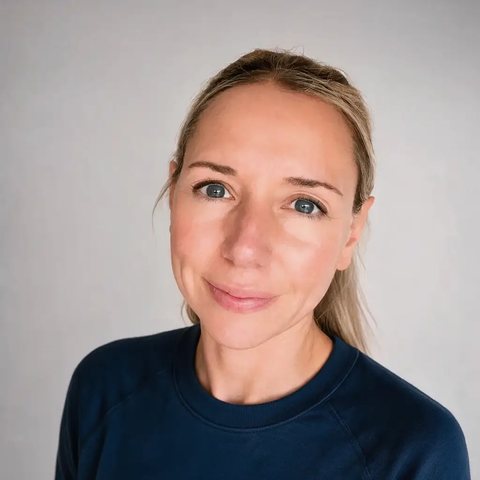
Anna Koutras
Co-founder
Anna spent over 13 years making complicated things clear for companies including Revolut, The Body Shop and Unilever. Ormi began when she and her friends started talking about perimenopause, and nobody could find straight answers.
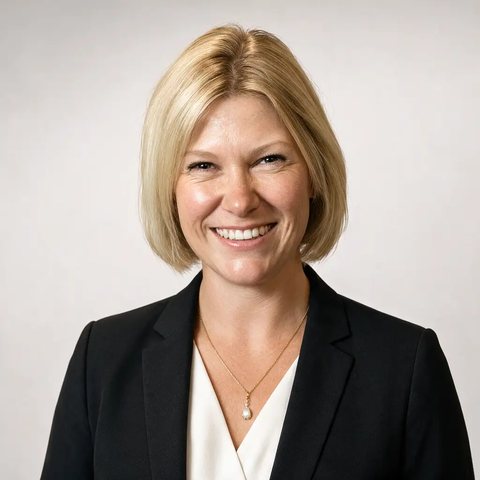
Dr Emma Whitehouse
Co-founder
Emma trained at Somerville College, Oxford and Guy's, King's and St Thomas' Medical School. She has been a GP for 14 years across the NHS and private practice, with postgraduate training in menopause care and functional medicine. She sees women in clinic who know something has changed and can't yet put a name to it, and she leads Ormi's clinical thinking.
Is Ormi right for you?
Straight answers to the questions we hear most. If yours isn't here, email hello@ormi.health.
Is Ormi right for me?
Ormi is for you if you don't feel like yourself lately and want to understand why, in plain words. It starts with how you feel, then connects that to your hormones, your wearable and your daily life. If what you need is a diagnosis or a prescription, that is a conversation for your GP. Ormi can help you prepare for it.
I'm not in perimenopause yet. Is it still for me?
Yes. Ormi is built for every moment of hormonal change. We're focused on perimenopause first, but it is relevant to you whatever stage you're in, including a regular cycle, postpartum and menopause.
Does Ormi diagnose perimenopause?
No. Ormi highlights patterns to discuss with a clinician. It does not diagnose, and it does not replace your GP.
Do I need to take the DUTCH test?
No. Ormi starts with a free hormone portrait and daily check-ins. The DUTCH test is optional, for when you want a deeper look. See how the tests compare.
How much does it cost?
Ormi has a free version: your hormone portrait, daily check-ins and core tools. Ormi Circle is £14.99 a month or £129 a year. Clinical insight, which includes the DUTCH test, a GP results review and a year of Ormi Circle, is a one-off £349 or £399.
Can I download Ormi now?
We're not on the App Store just yet, but if you join the waitlist we'll let you know as soon as it's ready! Got an idea that you would love to see in the app? Let's hear it! Send an email to hello@ormi.health. We love hearing your thoughts.
Who is behind Ormi?
Ormi was founded by Anna Koutras and Dr Emma Whitehouse, an NHS GP. You can meet the founders further up this page.
What happens to my data?
We never sell your data. Our privacy notice explains what we collect and why.